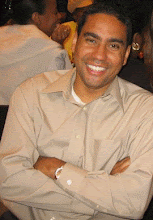
I was fortunate enough to come in contact with the Laughing Muslim blog which has some really great links to learn more about Islam. The links have certainly allowed me to walk through doors that I other wise would not have known were there.
I clicked on the link to Why Islam? and there I was able to listen to the recitation of the Qu'ran. The feature is awesome because you hear the Arabic reading and then an English translation. However, I soon ditched the English translation so I could hear it recited straight through and beautifully sung in Arabic without interruption. I have to say that simply reading the Qu'ran to myself in English does this beautiful piece of work absolutely no justice at all. Hearing it in its original tongue really opened up feelings of grandeur and a great appreciation for how beautiful Islam is when it is not being hijacked by people consumed with hatred.
The words that I have read so far in the Suras have so much more meaning now and even though I do not understand the Arabic I can feel the intent which is full of humility and reverence; It is peaceful, harmless, and powerful. I must say that I have been serenaded by the words of Allah and his Prophet. If you believe in God I can't see how one could not resist the urge to draw nearer to Him after listening to such a beautiful rendition. Oh the joy that must fill the heart of the faithful Muslim who is able to recite the Qu'ran in the manner in which it was meant to be heard! Oh the joy every devout Muslim must feel in rendering homage to the being that is only One God, Merciful and all powerful! I hope that people will open their hearts and minds and see what I have started to see, the beauty that is Islam.
This may all sound very strange coming from a non-Muslim. I don't really know how to address that, accept by saying my mind may not be open enough to believe but is is certainly open enough to appreciate and admire.
Friday, November 30, 2007


It just gets crazier and crazier!
So just when I wanted some clarity on the Muslim response in Sudan (see post below) I come across an article about how in Australia on Sydney's Southeast side, residents are opposing the building of an Islamic School. Two pigs heads were found with with the Australian flag between them on the proposed site.
This is sick beyond imagination. First it certainly was not necessary for two pigs to have to be destroyed so that hateful bigots could make a point. Second, how in the world to two thousand people come out to oppose the building of a Muslim school? Do ignorance, stupidity and hate have no limits?
People are so hateful sometimes I am ashamed even be human! Somehow in the minds of really stupid people death, war, and division are acceptable ways of life. How sad! You can read the article at this link. http://www.religionnewsblog.com/19998/islam-63
This is sick beyond imagination. First it certainly was not necessary for two pigs to have to be destroyed so that hateful bigots could make a point. Second, how in the world to two thousand people come out to oppose the building of a Muslim school? Do ignorance, stupidity and hate have no limits?
People are so hateful sometimes I am ashamed even be human! Somehow in the minds of really stupid people death, war, and division are acceptable ways of life. How sad! You can read the article at this link. http://www.religionnewsblog.com/19998/islam-63
Question?
I have finished Sura 3, however before I get into my thoughts, I can't help but wander if I am offending those who follow Islam. As a non believer I am trying to be as objective as possible but I would not want to incite anger. The reason why I am wondering this is because of what has happened to the British teacher Gillian Gibbons in Sudan. She was jailed for allowing school children to name a teddy bear Mohammad. I am not sure if this bear was intended to be named after the Prophet or just a given a name that is very popular.
In reading the article http://edition.cnn.com/2007/WORLD/africa/11/30/sudan.bears/ I am a little dumbfounded that many are whipping themselves up into a violent frenzy. Part me can understand why Muslims would be angry. Non Believers have to be careful with the liberties they take while in countries where religion is so important to the people that live there. However, the actions of the mob outside the courthouse yielding swords and sticks declaring they will physically fight for the Prophet seems a bit much. Perhaps I'm being insensitive but this is one fifty something year old woman; swords, sticks and the promise for a "popular release of anger" whatever that means, seems a bit much and quite frankly flat out ridiculous.
I would be open to any explanation from a faithful Muslims as to why violence has to be the proof of faith. let me know also if my endeavour to better understand Islam, with no intention of submitting, is offensive or acceptable. I'm sure I will continue my path regardless but it would be good to know where I stand in the eyes of the faithful.
Every religion has its moments of embarrassment when people and or leaders say and react to issues in totally crazy and inappropriate ways and I certainly am sad to say that for Islam this looks to be one of those embarrassing moments.
In reading the article http://edition.cnn.com/2007/WORLD/africa/11/30/sudan.bears/ I am a little dumbfounded that many are whipping themselves up into a violent frenzy. Part me can understand why Muslims would be angry. Non Believers have to be careful with the liberties they take while in countries where religion is so important to the people that live there. However, the actions of the mob outside the courthouse yielding swords and sticks declaring they will physically fight for the Prophet seems a bit much. Perhaps I'm being insensitive but this is one fifty something year old woman; swords, sticks and the promise for a "popular release of anger" whatever that means, seems a bit much and quite frankly flat out ridiculous.
I would be open to any explanation from a faithful Muslims as to why violence has to be the proof of faith. let me know also if my endeavour to better understand Islam, with no intention of submitting, is offensive or acceptable. I'm sure I will continue my path regardless but it would be good to know where I stand in the eyes of the faithful.
Every religion has its moments of embarrassment when people and or leaders say and react to issues in totally crazy and inappropriate ways and I certainly am sad to say that for Islam this looks to be one of those embarrassing moments.
Wednesday, November 28, 2007
Sufi Poem
Along with my reading of the Qu'ran I am also reading some suplamental material as well. I just finished reading the secion on Islam in The Worlds Religions by Huston Smith. In one section he introduces Sufism and there is a beautiful poem that I would like to share.
It was convinced, however, that its destiny was to cross this desert, and yet there was no way. Now a hidden voice, coming from the desert itself, whispered: "The wind crosses the desert, and so can the stream."
The stream objected that it was dashing itself against the sand, and only getting absorbed: that the wind could fly, and this was why it could cross a desert.
"By hurtling in your own accustomed way you cannot get across. You will either disappear or become a marsh. You must allow the wind to carry you over, to your destination.
But how could this happen? "By allowing yourself to be absorbed in the wind."
This idea was not acceptable to the stream. After all, it had never been absorbed before. It did not want to lose its individuality. And, once having lost it, how was one to know that it could ever be regained?
"The wind, "said the sand, "performs this function. It takes up water, carries it over the desert, and then lets it fall again. Falling as rain, the water again becomes a river."
"How can I know that this is true?" "It is so, and if you do not believe it, you cannot become more than a quagmire, and even that could take many, many years. And it certainly is not the same as a stream."
"But can I not remain the same stream that I am today?"
"You cannot in either case remain so," the whisper said. "Your essential part is carried away and forms a stream again. You are called what you are even today because you do not know which part of you is the essential one."
When it heard this, certain echoes began to arise in the thoughts of the stream. Dimly it remembered a state in which it - or some part of it? - had been held in the arms of a wind. It also remembered - or did it? - that this was the real thing, not necessarily the obvious thing to do.
And the stream raised its vapor into the welcoming arms of the wind, which gently and easily bore it upwards and along, letting it fall softly as soon as they reached the roof of a mountain, many, many miles away. And because it had its doubts, the stream was able to remember and record more strongly in its mind the details of the experience. It reflected, "Yes, now I have learned my true identity."
The stream was learning. But the sands whispered: "We know, because we see it happen day after day: and because we, the sands, extend from the riverside all the way to the mountain."
And that is why it is said that the way in which the stream of Life is to continue on its journey is written in the Sands."
A stream, from its course in far-off mountains, passing through every kind and description of countryside, at last reached the sands of the desert. Just as it had crossed every other barrier, the stream tried to cross this one, but found that as fast as it ran into the sand, its waters disappeared.
It was convinced, however, that its destiny was to cross this desert, and yet there was no way. Now a hidden voice, coming from the desert itself, whispered: "The wind crosses the desert, and so can the stream."
The stream objected that it was dashing itself against the sand, and only getting absorbed: that the wind could fly, and this was why it could cross a desert.
"By hurtling in your own accustomed way you cannot get across. You will either disappear or become a marsh. You must allow the wind to carry you over, to your destination.
But how could this happen? "By allowing yourself to be absorbed in the wind."
This idea was not acceptable to the stream. After all, it had never been absorbed before. It did not want to lose its individuality. And, once having lost it, how was one to know that it could ever be regained?
"The wind, "said the sand, "performs this function. It takes up water, carries it over the desert, and then lets it fall again. Falling as rain, the water again becomes a river."
"How can I know that this is true?" "It is so, and if you do not believe it, you cannot become more than a quagmire, and even that could take many, many years. And it certainly is not the same as a stream."
"But can I not remain the same stream that I am today?"
"You cannot in either case remain so," the whisper said. "Your essential part is carried away and forms a stream again. You are called what you are even today because you do not know which part of you is the essential one."
When it heard this, certain echoes began to arise in the thoughts of the stream. Dimly it remembered a state in which it - or some part of it? - had been held in the arms of a wind. It also remembered - or did it? - that this was the real thing, not necessarily the obvious thing to do.
And the stream raised its vapor into the welcoming arms of the wind, which gently and easily bore it upwards and along, letting it fall softly as soon as they reached the roof of a mountain, many, many miles away. And because it had its doubts, the stream was able to remember and record more strongly in its mind the details of the experience. It reflected, "Yes, now I have learned my true identity."
The stream was learning. But the sands whispered: "We know, because we see it happen day after day: and because we, the sands, extend from the riverside all the way to the mountain."
And that is why it is said that the way in which the stream of Life is to continue on its journey is written in the Sands."
Saturday, November 24, 2007
Sura 2 Part 2
OK, I had a few quiet moments on Thanksgiving morning to finish reading the second Sura. As I read this Sura I couldn't help but feel like I was reading a combination of the law of Moses, poetry, proverbs and Epistles.
The Sura covers many moral and practical life issues and tends to jump around a bit which can at times be hard to follow. The thing I tried to do to help me follow along was to keep the overall context before me. I looked at it like a father giving advise to his child before going to college or getting married. The father just tries to get all the words of wisdom he can before sending his child into the world so, somethings are going to makes sense right away and at other things will make more sense later.
There are a couple of verses that introduce the first ideas of war for religious sake and the condoning of violence. However, this is not much different from what I have read in the Old Testament of the Bible. If someone believed they wanted to kill in the name of God I could certainly see how they could come to that conclusion by reading either book. Personally, I detest the idea of war and fighting. It is the lazy way of resolving conflict and people all through history have used religion as a rationale for war and it is not surprising to see it clearly used in these holy books.
Like I have mentioned war for religious purposes it is a theme that is in most theistic literature and I still believe that while it is there, killing or dying for God does not serve as the preferred way of showing how strong ones faith and belief are. However, I also think that the idea of Martyrdom and dying for the cause is actually the easy cop out that involves really no sacrifice. I hate to digress but think about it for a second. If I believe that when I die as a Martyr I get a reward in heaven that is the simple an easy route to life. I make one big sacrifice and in a split second it's over and I'm in paradise. If this were the main message of the Qur'an or the Bible it would simply be one page long.
The grunt work and real display of faith and devotion come in the toil of everyday life. In fact this Sura spends a great deal of time speaking to how you should lend money without charging interest, treat your wife in matters of divorce, marriage, and death, giving to charity, and looking after the helpless. If Mohammad wanted to create a religion of martyrs we'd be talking about Islam the way we talk about the ancient religions of Greece, something people once believed but no longer do. This Sura is particularly concerned with the moral conduct of believers and the ethical treatment of the community. There are strong elements of compassion and kindness that are expected from human beings and are the attributes most often ascribed to Allah. He is merciful, forbearing, kind, wise etc.
There are some texts I would like to tackle and offer some objective criticisms about but I am really short on time and won't be able to do that in this post. Before I move on to the third Sura I will post those critiques next week.
The Sura covers many moral and practical life issues and tends to jump around a bit which can at times be hard to follow. The thing I tried to do to help me follow along was to keep the overall context before me. I looked at it like a father giving advise to his child before going to college or getting married. The father just tries to get all the words of wisdom he can before sending his child into the world so, somethings are going to makes sense right away and at other things will make more sense later.
There are a couple of verses that introduce the first ideas of war for religious sake and the condoning of violence. However, this is not much different from what I have read in the Old Testament of the Bible. If someone believed they wanted to kill in the name of God I could certainly see how they could come to that conclusion by reading either book. Personally, I detest the idea of war and fighting. It is the lazy way of resolving conflict and people all through history have used religion as a rationale for war and it is not surprising to see it clearly used in these holy books.
Like I have mentioned war for religious purposes it is a theme that is in most theistic literature and I still believe that while it is there, killing or dying for God does not serve as the preferred way of showing how strong ones faith and belief are. However, I also think that the idea of Martyrdom and dying for the cause is actually the easy cop out that involves really no sacrifice. I hate to digress but think about it for a second. If I believe that when I die as a Martyr I get a reward in heaven that is the simple an easy route to life. I make one big sacrifice and in a split second it's over and I'm in paradise. If this were the main message of the Qur'an or the Bible it would simply be one page long.
The grunt work and real display of faith and devotion come in the toil of everyday life. In fact this Sura spends a great deal of time speaking to how you should lend money without charging interest, treat your wife in matters of divorce, marriage, and death, giving to charity, and looking after the helpless. If Mohammad wanted to create a religion of martyrs we'd be talking about Islam the way we talk about the ancient religions of Greece, something people once believed but no longer do. This Sura is particularly concerned with the moral conduct of believers and the ethical treatment of the community. There are strong elements of compassion and kindness that are expected from human beings and are the attributes most often ascribed to Allah. He is merciful, forbearing, kind, wise etc.
There are some texts I would like to tackle and offer some objective criticisms about but I am really short on time and won't be able to do that in this post. Before I move on to the third Sura I will post those critiques next week.
Wednesday, November 21, 2007
Sorry for the Delay
Hello all,
I have been swamped with a personal matter that involves a great deal of my time. Out of respect for Islam and the Koran I don't read on the fly like I may other books. I try to make sure I have some quite time and that my mind and heart are open to what I read.
The past few weeks I have been attending to a family matter that takes a great deal of my time and there is not enough time in the day. Please continue to check in; and you may want to subside to this blog so you get email updates when there is post.
Thank you,
Rafael
I have been swamped with a personal matter that involves a great deal of my time. Out of respect for Islam and the Koran I don't read on the fly like I may other books. I try to make sure I have some quite time and that my mind and heart are open to what I read.
The past few weeks I have been attending to a family matter that takes a great deal of my time and there is not enough time in the day. Please continue to check in; and you may want to subside to this blog so you get email updates when there is post.
Thank you,
Rafael
Saturday, November 10, 2007
Sura 2 Part 1
Well unfortunately I left my copy of the Qu'ran at work. I read a lot of things during the day so I have been trying to read the Qu'ran during my lunch break and sometimes before I go to bed. But I left early from work on Friday so I walked out without it.
I just want to give small summary of what I have read so far and then follow up in a "Part 2" Post next week. I am half way through the second Sura and there are several interesting things to note. First off it is clear that Mohammad was a man who knew a great deal about the religious cultures and beliefs of his day. While reading this sura I get the sense that the theistic religious communities were close in a democrat and republican kind of way. Second he is quite aware of the Jewish history as recorded in the Old Testament and the arguments of the day used by both Christians and Jews as to what made their beliefs superior.
Those who practice Islam may say this was the result of the Qu'ran being inspired or dictated to Mohammad by Gabriel. I don't think his angelic encounter alone is what makes Mohammad special. it is clear that he was a man of the times and a religious genius. Personally, as a secularist I am filled with admiration for his knowledge of both religious traditions and his ability to weave out his own and still show a great deal of tolerance. Not to acknowledge his familiarity with the religious culture of the day does a great disservice to his brilliance.
Finally, from what I have read of this Sura so far it feels as if I am reading something right out of the New Testament epistles and Old Testament Prophets. It is strangely familiar and an open minded Christan or Jewish person may be able to see the stark similarites.
There are some pretty amazing quotes that I have highlighted but since I don't have the copy with me I can't go into detail. I'll talk more about them next week and hopefully by then I would have finished the entire 2nd Sura.
I just want to give small summary of what I have read so far and then follow up in a "Part 2" Post next week. I am half way through the second Sura and there are several interesting things to note. First off it is clear that Mohammad was a man who knew a great deal about the religious cultures and beliefs of his day. While reading this sura I get the sense that the theistic religious communities were close in a democrat and republican kind of way. Second he is quite aware of the Jewish history as recorded in the Old Testament and the arguments of the day used by both Christians and Jews as to what made their beliefs superior.
Those who practice Islam may say this was the result of the Qu'ran being inspired or dictated to Mohammad by Gabriel. I don't think his angelic encounter alone is what makes Mohammad special. it is clear that he was a man of the times and a religious genius. Personally, as a secularist I am filled with admiration for his knowledge of both religious traditions and his ability to weave out his own and still show a great deal of tolerance. Not to acknowledge his familiarity with the religious culture of the day does a great disservice to his brilliance.
Finally, from what I have read of this Sura so far it feels as if I am reading something right out of the New Testament epistles and Old Testament Prophets. It is strangely familiar and an open minded Christan or Jewish person may be able to see the stark similarites.
There are some pretty amazing quotes that I have highlighted but since I don't have the copy with me I can't go into detail. I'll talk more about them next week and hopefully by then I would have finished the entire 2nd Sura.
Saturday, November 3, 2007
Still Reading
I am still reading through the second SURA. If I don't finish by Sunday I'll post about what I have read up to that point.
Friday, November 2, 2007
SURA 1 AL-FATIHA
Last evening before I went to bed I read the first SURA AL-FATIHA and up to verse 62 of SURA 2 AL-BAQARAH of the Qur'an.
SURA 1 opens with a prayer that, from my reading covers four elements. (1) The prayer describes the Nature of God; Most Gracious, Most Merciful, Cherisher and Sustainer of the World, Master of the Day of Judgment. God is described in this prayer as a being who cares deeply for His creation and one who will vindicate and reward those who have chosen to honor Him. (2) God is one who helps his followers and humble followers should depend on Him for help and aid; vrs. 5 You do we worship, and your aid we seek. (3) Morality; vrs. 6 Show us the straight way (4) Tradition and Obedience; vrs. 6-7 Show us the straight way, the way of those on whom you have bestowed your Grace, those whose portion is not wrath. And who go not astray.
Now mind you I am no Islamic theologian and these are just my observations. These four elements seem to blend heavily into the second SURA and the elements of the prayer may be the very theme of the entire book for it already starts to play heavily into the first 62 verses of the second SURA, which I am still in the process of reading.
I must say that what I have read thus far is fairly easy to understand. It could be a combination of the English translation that I have and the fact that I read the introduction which gave me some background and insight on how to read the book. I also think that going into this reading with as much of an open mind as possible helps. While I certainly do not agree with some of the statements regarding those who reject Faith; As to those who reject Faith, it is the same to them whether you warn them or do not warn them; they will not believe. Allah has set a seal on their hearts and on their hearing. And on their eyes is a veil; great is the chastisement they (incur) SURA 2:6-7 I can't really argue with the logic or the point of view. My intention is not to make arguments, although that will probably happen from time to time, but instead to gain understanding for the sake of peace and harmony.
The amazing thing is that for theistic centered religious literature the style and writing of the Qur'an is incredibly clear and plain in language. Again however I must emphasize I have not read too far into the book so I don't know if I will run into apocalyptic writings or other types of genres common to scripture that will prove more challenging.
In some of the theistic religious literature I have read, when the author begins to make theological arguments such as those found in the Pauline Epistles in the New Testament of the Bible and the ethical discussions between Krisna and Arjuna regarding war and duty in the Bhagavad-Gita for example, the waters can seem to get muddy and hard to wade through. However I find the Qur'an to be quite cut and dry and easy to follow. There are some details that I do not yet understand such as why "We" is used instead of "I" when Allah speaks. The use of We instead of I could be a literary tool as to include all of God's messengers of the past and present who are speaking or testifying through one voice. Nevertheless, the overall premise is quite easy to follow and I haven't yet got lost in the small details I don't quite understand as of yet.
At any rate I forgot to mention that I received my copy of the Qur'an for free. I ordered it online at http://www.alarqamdawacenter.com/. It came to me in the mail and no Federal Agents have stormed my home yet so I guess it's safe. For those of you who may be afraid of ending up on a no fly list you may feel better going the mainstream rout and buying a Qur'an at Borders or something. But I would certainly recommend reading it.
SURA 1 opens with a prayer that, from my reading covers four elements. (1) The prayer describes the Nature of God; Most Gracious, Most Merciful, Cherisher and Sustainer of the World, Master of the Day of Judgment. God is described in this prayer as a being who cares deeply for His creation and one who will vindicate and reward those who have chosen to honor Him. (2) God is one who helps his followers and humble followers should depend on Him for help and aid; vrs. 5 You do we worship, and your aid we seek. (3) Morality; vrs. 6 Show us the straight way (4) Tradition and Obedience; vrs. 6-7 Show us the straight way, the way of those on whom you have bestowed your Grace, those whose portion is not wrath. And who go not astray.
Now mind you I am no Islamic theologian and these are just my observations. These four elements seem to blend heavily into the second SURA and the elements of the prayer may be the very theme of the entire book for it already starts to play heavily into the first 62 verses of the second SURA, which I am still in the process of reading.
I must say that what I have read thus far is fairly easy to understand. It could be a combination of the English translation that I have and the fact that I read the introduction which gave me some background and insight on how to read the book. I also think that going into this reading with as much of an open mind as possible helps. While I certainly do not agree with some of the statements regarding those who reject Faith; As to those who reject Faith, it is the same to them whether you warn them or do not warn them; they will not believe. Allah has set a seal on their hearts and on their hearing. And on their eyes is a veil; great is the chastisement they (incur) SURA 2:6-7 I can't really argue with the logic or the point of view. My intention is not to make arguments, although that will probably happen from time to time, but instead to gain understanding for the sake of peace and harmony.
The amazing thing is that for theistic centered religious literature the style and writing of the Qur'an is incredibly clear and plain in language. Again however I must emphasize I have not read too far into the book so I don't know if I will run into apocalyptic writings or other types of genres common to scripture that will prove more challenging.
In some of the theistic religious literature I have read, when the author begins to make theological arguments such as those found in the Pauline Epistles in the New Testament of the Bible and the ethical discussions between Krisna and Arjuna regarding war and duty in the Bhagavad-Gita for example, the waters can seem to get muddy and hard to wade through. However I find the Qur'an to be quite cut and dry and easy to follow. There are some details that I do not yet understand such as why "We" is used instead of "I" when Allah speaks. The use of We instead of I could be a literary tool as to include all of God's messengers of the past and present who are speaking or testifying through one voice. Nevertheless, the overall premise is quite easy to follow and I haven't yet got lost in the small details I don't quite understand as of yet.
At any rate I forgot to mention that I received my copy of the Qur'an for free. I ordered it online at http://www.alarqamdawacenter.com/. It came to me in the mail and no Federal Agents have stormed my home yet so I guess it's safe. For those of you who may be afraid of ending up on a no fly list you may feel better going the mainstream rout and buying a Qur'an at Borders or something. But I would certainly recommend reading it.
Thursday, November 1, 2007
The Reason Behind it All
I gave a little of an introduction in my nothinkerbehindthethought blog http://nothinker.blogspot.com/ entitled Reading the Qur'an which I posted on November 1st and was the genesis for this blog.
Let me start off by saying I am not what you would consider a religious person in the technical sense of the phrase. I am certainly a spiritual person and I have a healthy respect for things deemed holy. At the same time I am skeptical of religion and do not subscribe to the existence of a higher power. The idea of God, or a higher power is not important to me but it is extremely important to countless people on this planet. I know this not only because of observations in society but because I went to college to become a Christian Pastor and at one time in my life my religious beliefs were the only thing that really mattered to me in the world.
I have read the Bible from Genesis to Revelation at least four times and I can't tell you how many times I have read various individual books in the Bible not to mention my scholastic training. Thus I am usually quite comfortable discussing just about any Biblical topic
Islam is in danger today from extremists within the religion but more so from ignorant intellectually lazy citizens who see a bomb go off and simply write the act off to fanaticism. Furthermore they see acts of terror as having their source in the Qur'an.
Look, the President goes on TV after 9/11 and says we are not at war with Muslims yet every time he talks about the so called war on terror Islam is somewhere in his phraseology. i.e. IslamoFascists, Islamists and Islamic Extremists. Any flag waving red blooded American can't help but think "terrorist" when they think of Islam.
Think of the impact the President could have made if he said "Folks I sat down and read the Qur'an for myself and I can tell you personally from my reading and my own understanding of it, these acts of terror are not condoned. Furthermore I would encourage all Americans to read the Qur'an for themselves and educate themselves about the religion and culture so we better understand our peaceful Muslim friends and allies. Perhaps then we can work together to combat the threats we all face from terrorism. My friends we have nothing to fear from peace loving Muslims, think about it folks, if the Qur'an condoned terror we would have some real problems because that would mean every devout Muslim would be committing acts of terrorism. The fact that they are not committing terrorist acts in droves should say something about the nature of the Qur'an and Islam"
Again I have no idea what I will discover as I read this book. Based on some of the history I have heard about the Prophet Mohammad, blessings be upon him, violence and war were part of the experience of Islam. However, that is the case for most theistic religions. I know from my reading of the Bible and most recently my reading of the Bhagavad-Gita, that war and violence committed by human beings tends to be woven into divine will. These texts, scriptures etc. have been used to justify all kinds of atrocities so there is always the potential that people and governments could use their holy books to justify acts of violence upon infidels, witches, natives, homosexuals, idol worshipers or any one else worthy of divine wrath.
Islam however has the distinct misfortune of being projected through the lens of the western perspective. There are people who have no idea of the history between Christianity and Islam and how thousands of years of bad blood and policies have affected this relationship. It wasn't that we woke up one morning and people were flying airplanes into buildings because they hate democracy. I don't condone violence but I can tell you that hog wash about how terrorists hate democracy, freedom and the American Past Time is all propaganda to make it seem as if America can do no wrong in the world.
At any rate I'll stop here and get back as I read through the first Sura.
MYBWH&P!
Let me start off by saying I am not what you would consider a religious person in the technical sense of the phrase. I am certainly a spiritual person and I have a healthy respect for things deemed holy. At the same time I am skeptical of religion and do not subscribe to the existence of a higher power. The idea of God, or a higher power is not important to me but it is extremely important to countless people on this planet. I know this not only because of observations in society but because I went to college to become a Christian Pastor and at one time in my life my religious beliefs were the only thing that really mattered to me in the world.
I have read the Bible from Genesis to Revelation at least four times and I can't tell you how many times I have read various individual books in the Bible not to mention my scholastic training. Thus I am usually quite comfortable discussing just about any Biblical topic
Islam is in danger today from extremists within the religion but more so from ignorant intellectually lazy citizens who see a bomb go off and simply write the act off to fanaticism. Furthermore they see acts of terror as having their source in the Qur'an.
Look, the President goes on TV after 9/11 and says we are not at war with Muslims yet every time he talks about the so called war on terror Islam is somewhere in his phraseology. i.e. IslamoFascists, Islamists and Islamic Extremists. Any flag waving red blooded American can't help but think "terrorist" when they think of Islam.
Think of the impact the President could have made if he said "Folks I sat down and read the Qur'an for myself and I can tell you personally from my reading and my own understanding of it, these acts of terror are not condoned. Furthermore I would encourage all Americans to read the Qur'an for themselves and educate themselves about the religion and culture so we better understand our peaceful Muslim friends and allies. Perhaps then we can work together to combat the threats we all face from terrorism. My friends we have nothing to fear from peace loving Muslims, think about it folks, if the Qur'an condoned terror we would have some real problems because that would mean every devout Muslim would be committing acts of terrorism. The fact that they are not committing terrorist acts in droves should say something about the nature of the Qur'an and Islam"
Again I have no idea what I will discover as I read this book. Based on some of the history I have heard about the Prophet Mohammad, blessings be upon him, violence and war were part of the experience of Islam. However, that is the case for most theistic religions. I know from my reading of the Bible and most recently my reading of the Bhagavad-Gita, that war and violence committed by human beings tends to be woven into divine will. These texts, scriptures etc. have been used to justify all kinds of atrocities so there is always the potential that people and governments could use their holy books to justify acts of violence upon infidels, witches, natives, homosexuals, idol worshipers or any one else worthy of divine wrath.
Islam however has the distinct misfortune of being projected through the lens of the western perspective. There are people who have no idea of the history between Christianity and Islam and how thousands of years of bad blood and policies have affected this relationship. It wasn't that we woke up one morning and people were flying airplanes into buildings because they hate democracy. I don't condone violence but I can tell you that hog wash about how terrorists hate democracy, freedom and the American Past Time is all propaganda to make it seem as if America can do no wrong in the world.
At any rate I'll stop here and get back as I read through the first Sura.
MYBWH&P!
Subscribe to:
Posts (Atom)